When the Faders Come Up


Years ago, I was talking with a sound engineer I knew about the art of mixing music.

He told me a story that has stayed with me ever since, and it is beginning to make sense in today’s geopolitical climate.

He was asked to mix a multitrack recording of a blues band. He instantly regretted saying yes when he began soloing the individual tracks.

The vocal sounded rough, almost painful.
The bass felt sloppy and uncertain.
The drums weren’t particularly tight.

If you heard any one of them alone, you might have thought, This isn’t going to work.

Then he brought all the faders up together.

What came out of the speakers was glorious.

It was emotional.
It was cohesive.
It was alive.

The band didn’t sound broken.
It sounded human.

And somehow, in the blend, all the rough edges found their place.

That was his lesson.

Stop obsessing over every isolated imperfection.
Start listening to the whole.

Where We Are

We live in a world that’s forgotten how to do that.

We are constantly soloing tracks.

We solo countries.
We solo cultures.
We solo identities.
We solo headlines.

And when we do, we hear flaws.

We hear distortion.
We hear imbalance.
We hear things that feel unfinished.

But nothing in the world was ever meant to be heard in isolation.

No single instrument carries the song.
No single nation carries humanity.

The music only emerges when the faders come up together.

The Deeper Truth

There is a deeper truth here.

When you solo a track long enough, you stop hearing music.
You start hearing imperfections.

That’s where we are culturally.

We magnify differences.
We amplify mistakes.
We critique endlessly.

It’s as if we believe that if we just tune every instrument perfectly in isolation, harmony will automatically appear.

But that isn’t how music works.

And it isn’t how civilization works either.

Perfection Is the Enemy

In mixing, perfection is often the enemy of life.

Over-tune the vocal and you lose its soul.
Over-quantize the drums and you lose the groove.
Over-compress the track and you lose the breath.

Sometimes what sounds flawed alone is what makes the whole feel real.

The slight rasp in the voice becomes emotion.
The looseness in the rhythm becomes feel.
The friction becomes energy.

Difference, in context, becomes beauty.

What We Need

The Nous Age, will not be an age of uniformity.

It will be an age of conscious blending.

An age where we understand that humanity is not a solo performance.
It is an ensemble.

No culture needs to disappear for the music to work.
No nation needs to be erased for harmony to exist.
No identity needs to be tuned into sameness.

What we need is balance.

We need listening.

We need perspective.

We need to hear the whole before we judge the parts.

It’s In the Mix

Think about it.

A single neuron doesn’t think.
A single note doesn’t move us.
A single voice doesn’t create a civilization.

But networks do.
Ensembles do.
Interconnection does.

The miracle is not in the track.

It’s in the mix.

Shift the Focus

Maybe the work of this century is not to fix every isolated imperfection.

Maybe it is to raise the faders together.

To widen the frame.
To shift from critique to context.
To hear humanity not as fragments, but as an emerging composition.

Because when you listen to the whole, something changes.

You begin to hear coherence where before you heard chaos.
You begin to feel belonging where before you felt division.
You begin to sense that the music was always there.

We just weren’t listening properly.

Is Anything “Wrong”

The Nous Age begins the moment we stop asking,
“What’s wrong with this track?”

And start asking,

“What happens when we let the ensemble play?”

And then — bravely —
we bring the faders up.

Neil deGrasse Tyson on the Cosmic Perspective


I was introduced to him through the PBS program NOVA ScienceNow which he hosted from 2006-2011, but have become even more intrigued by what’s he’s had to say since then.

Neil deGrasse Tyson is an astrophysicist and director of the Hayden Planetarium in New York City. He is a plain spoken deep thinker. This video is the perfect example. I hope it opens your eyes a bit wider:


Later this year Neil will host a 13-part TV series to serve as a sequel and modern update to Carl Sagan’s Cosmos: A personal Journey.

You can follow Neil on Twitter here: https://twitter.com/neiltyson

Alan Watts, Love Everything


I just discovered this amazing little video and wanted to share it here as a thought provoker as more and more people are drawn toward The Nous Age and what it is. I have never felt the peace I feel while looking up, out into the Universe with my Meade telescope. It’s the greatest show on Earth!

God is Consciousness


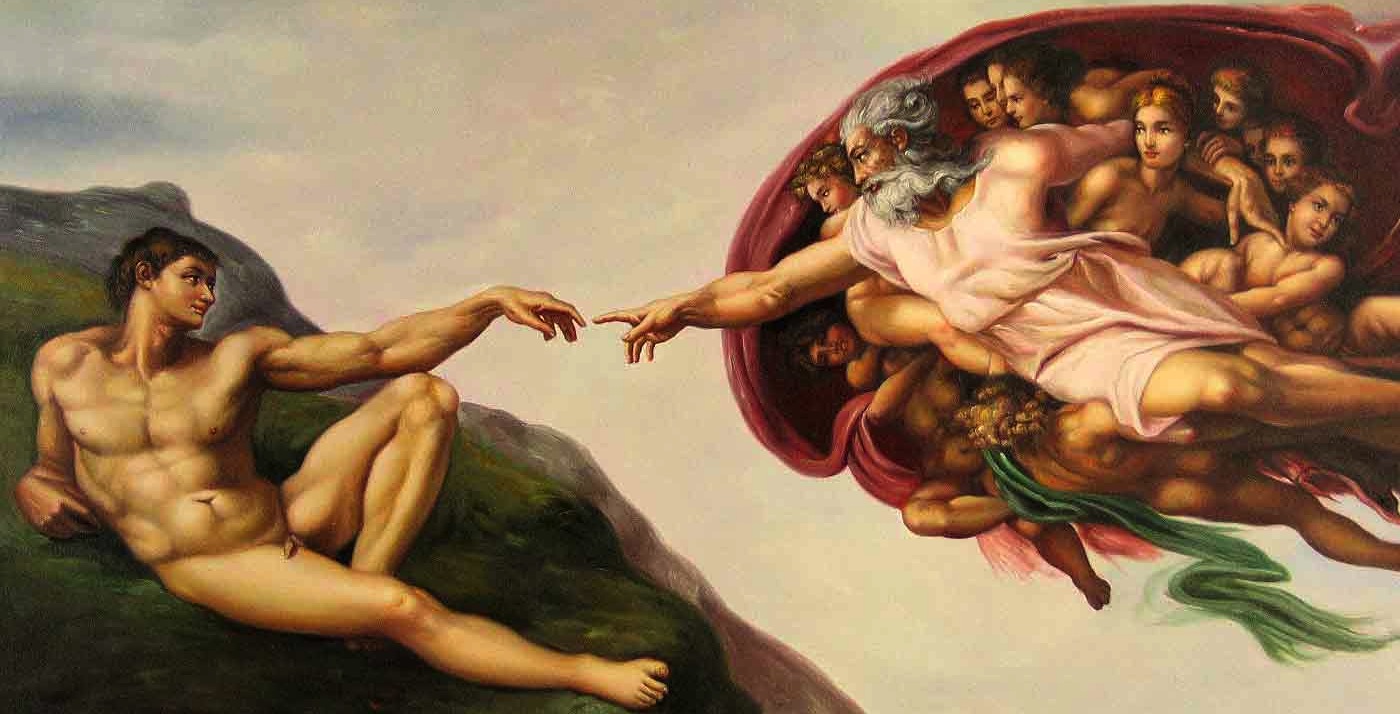
The Creation of Man (Michelangelo)

The Creation of Man (Michelangelo)

1 In the beginning was the Word, and the Word was with God, and the Word was God. 2 He was with God in the beginning.

3 Through him all things were made; without him nothing was made that has been made. 4 In him was life, and that life was the light of men. 5 The light shines in the darkness, but the darkness has not understood it. (John 1:1-5 – New International Version 1984)

I try not to quote too much scripture on this blog and will likewise keep it to a minimum as I complete my book, but I came across this quote last night and it suddenly clicked with me.

What I Believe
My core conviction, the belief that has driven me to write is that we are only part of a sea of consciousness and that “Universal Consciousness” is what we in the Abrahamic tradition have come to call God.

In the book I am using bleeding edge science mixed with, archaeologic discoveries and the occasional religious insights to make my case, so when I read the above quote it suddenly dawned on me that “the word” is consciousness! 

In the beginning there was only consciousness…and that was God (1+2). That consciousness (conscious observation) creates our reality (3) as quantum physics tells us. That the light or spark inside all humans is that light of consciousness(4). And finally, that whether we acknowledge it or not (the darkness) that light of God shines in us and through us into our space-time material world!

The Source
While I don’t (and never will) rely on The Bible as factual evidence of anything I feel that there are some stories, particularly in the old testament that give incredible insight to beliefs of a long lost civilization going back perhaps 15,000 years and more.

For the most part the Old Testament and Torah, are an amalgamation of many oral traditions passed down through the eons and brought together as a single work between 600 and 400 BCE during the Babylonian Exile period. While the New Testament is a hodgepodge of information spliced together by the early Christian Church which had it’s own political agenda. And in fact, many biblical scholars question that the Gospel of John was even written by John. Perhaps the true author was someone with a much deeper understanding of the way the Universe works and camouflaged it for a future generation to discover.

A ‘Nous’ Understanding
Many new scientific discoveries are pointing toward the idea of one consciousness. A consciousness that created and continuously creates the Universe and everything in it that we experience as “reality”. Juxtapose these new discoveries with the quote from the book of John and you may suddenly realize that we are coming out of the darkness, that the veil is lifting.

We Are All One


I find the current world paradigm of separation repugnant.

Here in Québec there is talk again of separating from Canada, thankfully no where near a majority (30%). When Palestine was separated in 1948 it was likewise the opposite direction we should have gone, but in that case it wasn’t up to the Palestinians to decide, Western powers decided for them.

What we really need is a movement toward ONEness…Like the Global Oneness Day October 24th.

Watch this message from Neale Donald Walsch

As Above So Below


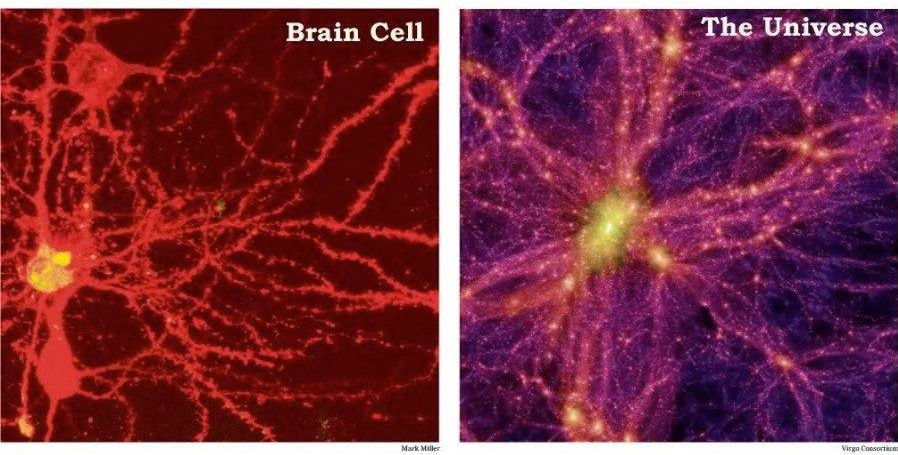
Mark Miller, a doctoral student in Brandeis University, is researching how particular types of neurones in the brain are connected to one another. By staining thin slices of a mouse’s brain, he can identify the connections visually. The image above shows the three neurone cells on the left (two red and one yellow) and their connections.

A international group of astrophysicist used a computer simulation last year to recreate how the Universe grew and evolved. The simulation image above (right) is a snapshot of the present Universe that features a large cluster of galaxies (bright yellow) surrounded by thousands of stars, galaxies and dark matter (web). (The New York Times)

One is only micrometers wide. The other is billions of light-years across. One shows neurones in a mouse brain. The other is a simulated image of the Universe. Together the suggest the surprisingly similar patterns found in vastly different natural phenomena. -DAVID CONSTANTINE

(Source: Mark Miller, Brandeis University; Virgo Consortium for Cosmological Supercomputer Simulations http://www.visualcomplexity.com)