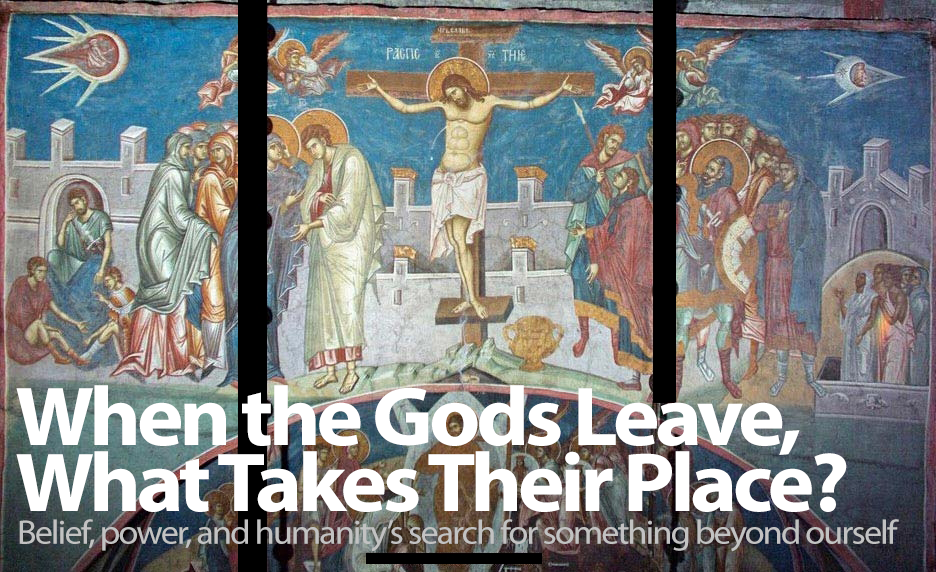
When the Gods Leave, What Takes Their Place?


Two thousand years ago, the Greek philosopher Plutarch observed that you could find cities without walls, kings, or wealth…but not cities without gods.

Two thousand years later, the gods appear to be leaving.

The question is whether our need for them went with them.

Across much of the Western world, organized religion has been losing its hold. Churches that once stood at the centre of community life struggle to fill their pews. Increasing numbers of people describe themselves as having no religion at all. Institutions that once claimed enormous authority over questions of morality, meaning, death and eternity no longer command the automatic obedience they once did.

It would be easy to conclude that humanity is simply becoming less religious.

But perhaps something more interesting is happening.

Perhaps belief doesn’t disappear.

Perhaps it changes containers.

The Space Religion Occupied

For thousands of years, religion did considerably more than tell us what happened after we died.

It placed us inside a story.

It told us where we came from. Why we were here. What was expected of us. What existed beyond the visible world. Whether there was an intelligence greater than our own. Whether someone or something was watching.

Religion provided community, ritual and moral structure. But it also provided mystery.

And human beings seem remarkably uncomfortable living without mystery.

This doesn’t mean religion was created simply to control people. History is rarely that tidy. Belief can emerge sincerely among ordinary people while institutions subsequently discover that belief has another property:

It has power.

Ancient Rome provides an extraordinary example.

When Rome Changed Its Mind

For centuries, Christians periodically faced Roman persecution. Their refusal to participate in aspects of Roman religious life could be interpreted as defiance of the social and political order.

Then something remarkable happened.

Rome stopped trying to destroy Christianity and began embracing it.

Constantine legalized Christianity in the early fourth century and increasingly patronized it. Later in that century, under Theodosius I, Nicene Christianity became bound increasingly closely to imperial authority.

But Rome did not invent Christianity. By the time Constantine embraced it, Christian communities had flourished for centuries across the Eastern Mediterranean, including ancient traditions that would eventually form the foundations of Eastern Orthodox Christianity.

Rome’s great achievement may therefore have been something subtler than creating a religion.

It recognized the power of one that was already there.

Imperial authority became involved in Christian disputes. Councils helped define orthodoxy. Certain interpretations became authoritative while others were increasingly pushed outside the boundaries of acceptable belief. Christianity itself developed within the surrounding Greek and Roman world, absorbing its language, philosophy and cultural environment.

Over time, belief and institutional power became deeply intertwined.

The lesson isn’t necessarily that powerful people invent religions to control populations.

The more interesting lesson may be that institutions can recognize an emerging belief system, organize it, legitimize particular interpretations of it and eventually become authorities over it.

Which brings us, rather unexpectedly, to the sky.
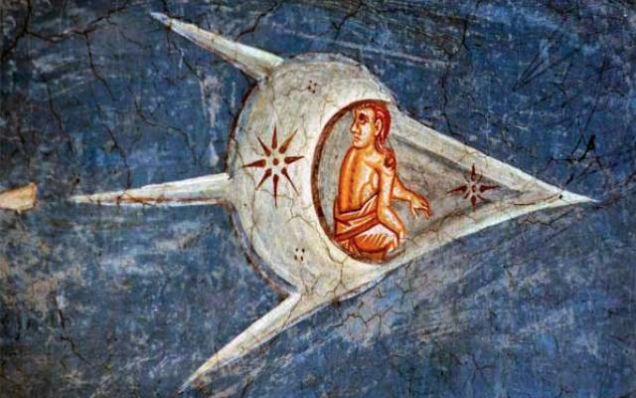
Something Is Changing Above Us

For most of the modern era, UFOs occupied the cultural territory of science fiction, tabloid newspapers and conspiracy theories.

That has changed.

With the Pentagon’s latest release of previously classified UAP material, the sixth release of its kind in roughly five months, we are being given another glimpse into just how seriously parts of the U.S. government have investigated phenomena once dismissed to the fringes. The newly released material includes records connected to a secretive military program that commissioned studies into subjects as extraordinary as wormholes, exotic propulsion and the possible biological effects of unexplained encounters.

None of this proves extraterrestrials are visiting Earth.

That distinction matters enormously.

But something culturally important can be happening regardless of whether a single extraterrestrial spacecraft has ever entered our atmosphere.

Look at the questions increasingly surrounding the phenomenon.

Are we alone?

Is there an intelligence greater than ours?

Where do we come from?

Could another intelligence have been watching us?

Is reality larger than what we can perceive?

What happens when humanity finally discovers that it isn’t at the centre of everything?

Those aren’t merely scientific questions.

They are some of the oldest questions human beings have ever asked.

We once carried many of them into temples and churches.

Increasingly, we’re carrying them elsewhere.

A New Container

This doesn’t require a secret government plan.

In fact, that’s precisely what makes the possibility more interesting.

Rome didn’t need to invent Christianity to recognize its cultural power. Christianity was already there.

Perhaps modern institutions don’t need to invent our fascination with extraterrestrial intelligence either.

It is already here.

The important question therefore may not be whether governments are preparing us to believe in extraterrestrials.

It may be what happens if millions of people begin believing anyway.

Who interprets the phenomenon?

Who determines which information is credible?

Who possesses the secret knowledge?

Who decides what gets revealed?

And perhaps most importantly: who becomes the authority standing between ordinary people and something they cannot understand for themselves?

Those questions should sound strangely familiar.

Because we’ve asked versions of them before.

Perhaps the most interesting thing about the decline of organized religion isn’t that Western societies are abandoning belief.

Perhaps we’re watching belief migrate from churches and scriptures toward consciousness, the cosmos and the possibility that we are not alone.

Plutarch couldn’t imagine congressional hearings about unidentified objects moving through the sky.

But I suspect he would recognize the people watching them.

Because two thousand years later, humanity may still be doing what it has always done:

Looking upward.

Searching for something greater than ourselves.

Trying to understand our place in an enormous and mysterious universe.

Perhaps belief doesn’t disappear.

Perhaps it simply changes containers.

Jesus, Son of God?


dreamstime_2364068

Sometimes, it seems that the more I learn the less I know.

Growing up in a religious Orthodox Christian family, I took all of the stories around Christ’s life as fact, the unquestionable truth. But the more I dig, looking for clearer understand, I find only a shifting foundation of sand.

Take for example the Jesus, Osiris, Dionysus connection.

Jesus, Osiris, Dionysus
Dionysus, a Greek God (1500—1100 BC) and Osiris, an Egyptian God (pre-2500 BC) were viewed as ‘mythical’ characters…though there is some evidence that points to Osiris as being real and that Dionysus was only modelled after Osiris. Despite that the two characters were used interchangeably in ancient times and in the 3rd century they were even referred to by the composite name “Osiris-Dionysus“.

At the time of Jesus’ stay on the Earth some 2000 years ago the story of Dionysus and Osiris were well established but nobody seemed to notice the similarities between the 3 of them??

A Closer Look
The following stories appear both in the Gospels and in the myths of many of the god-men:

bullet Conception:

bullet God was his father. This was believed to be literally true in the case of Osiris-Dionysus; their God came to earth and engaged in sexual intercourse with a human. The father of Jesus is God in the form of the Holy Spirit (Matthew 1:18).
bullet A human woman, a virgin, was his mother.
bullet Birth:

bullet He was born in a cave or cowshed. Luke 2:7 mentions that Jesus was placed in a manger – an eating trough for animals. One early Christian tradition said that the manger was in a cave.
bullet His birth was prophesized by a star in the heavens.
bullet Ministry:

bullet At a marriage ceremony, he performed the miracle of converting water into wine.
bullet He was powerless to perform miracles in his home town.
bullet His followers were born-again through baptism in water.
bullet He rode triumphantly into a city on a donkey. Tradition records that the inhabitants waved palm leaves.
bullet He had 12 disciples.
bullet He was accused of licentious behavior.
bullet Execution, resurrection, etc:

bullet He was killed near the time of the Vernal Equinox, about MAR-21.
bullet He died “as a sacrifice for the sins of the world.
bullet He was hung on a tree, stake, or cross. 
bullet After death, he descended into hell.
bullet On the third day after his death, he returned to life.
bullet The cave where he was laid was visited by three of his female followers
bullet He later ascended to heaven.
bullet His titles:

bullet God made flesh.
bullet Savior of the world.
bullet Son of God.
bullet Beliefs about the God-man:

bullet He is “God made man,” and equal to the Father.
bullet He will return in the last days.
bullet He will judge the human race at that time.
bullet Humans are separated from God by original sin. The god-man’s sacrificial death reunites the believer with God and atones for the original sin.
Source: Religious Tolerance.org

Nobody Noticed?
The reason that nobody noticed the similarities between Jesus and Osiris-Dionysus was because those aspects of Jesus’ life were added hundreds of years later when Rome finally accepted Christianity and fused it with her other pagan beliefs.

Jesus Was A (Great) Man
I choose to believe that Jesus was a real person, a socialist, a rebel against a corrupt Roman-Jewish alliance and perhaps someone who through study and practice of mysticism had come to a deep understanding of the world, the Universe and our place in it. And from that understanding preached love and tolerance.

If we could follow THAT example, I think the world would be a better place.

God is Consciousness


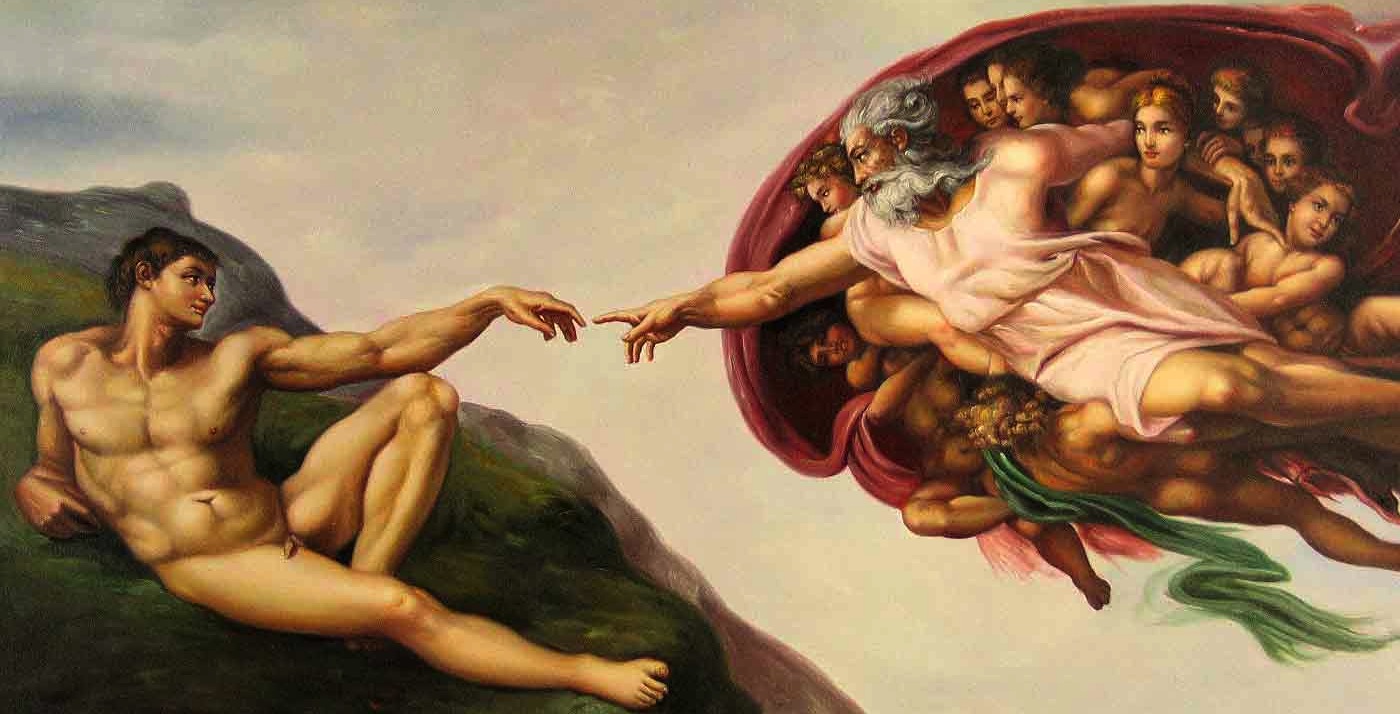
The Creation of Man (Michelangelo)

The Creation of Man (Michelangelo)

1 In the beginning was the Word, and the Word was with God, and the Word was God. 2 He was with God in the beginning.

3 Through him all things were made; without him nothing was made that has been made. 4 In him was life, and that life was the light of men. 5 The light shines in the darkness, but the darkness has not understood it. (John 1:1-5 – New International Version 1984)

I try not to quote too much scripture on this blog and will likewise keep it to a minimum as I complete my book, but I came across this quote last night and it suddenly clicked with me.

What I Believe
My core conviction, the belief that has driven me to write is that we are only part of a sea of consciousness and that “Universal Consciousness” is what we in the Abrahamic tradition have come to call God.

In the book I am using bleeding edge science mixed with, archaeologic discoveries and the occasional religious insights to make my case, so when I read the above quote it suddenly dawned on me that “the word” is consciousness! 

In the beginning there was only consciousness…and that was God (1+2). That consciousness (conscious observation) creates our reality (3) as quantum physics tells us. That the light or spark inside all humans is that light of consciousness(4). And finally, that whether we acknowledge it or not (the darkness) that light of God shines in us and through us into our space-time material world!

The Source
While I don’t (and never will) rely on The Bible as factual evidence of anything I feel that there are some stories, particularly in the old testament that give incredible insight to beliefs of a long lost civilization going back perhaps 15,000 years and more.

For the most part the Old Testament and Torah, are an amalgamation of many oral traditions passed down through the eons and brought together as a single work between 600 and 400 BCE during the Babylonian Exile period. While the New Testament is a hodgepodge of information spliced together by the early Christian Church which had it’s own political agenda. And in fact, many biblical scholars question that the Gospel of John was even written by John. Perhaps the true author was someone with a much deeper understanding of the way the Universe works and camouflaged it for a future generation to discover.

A ‘Nous’ Understanding
Many new scientific discoveries are pointing toward the idea of one consciousness. A consciousness that created and continuously creates the Universe and everything in it that we experience as “reality”. Juxtapose these new discoveries with the quote from the book of John and you may suddenly realize that we are coming out of the darkness, that the veil is lifting.

How Music Effects Us


You know how your favourite song makes you feel good? It’s based on science, a science of vibration and sound.

The Universe and everything in it is held together by a symphony of sound [1]. When we harmonize WITH it we feel great…when we’re “out of tune” with it we don’t. And if you’re out of tune for too long, you can make yourself ill.

We all know that matter is made of tiny atoms, electrons spinning around nucleuses at very specific “frequencies”. Have you ever wondered how sound outside the body effects us on the inside?

Watch this video:

Jesus, Bill Maher and The Fruit of Knowledge


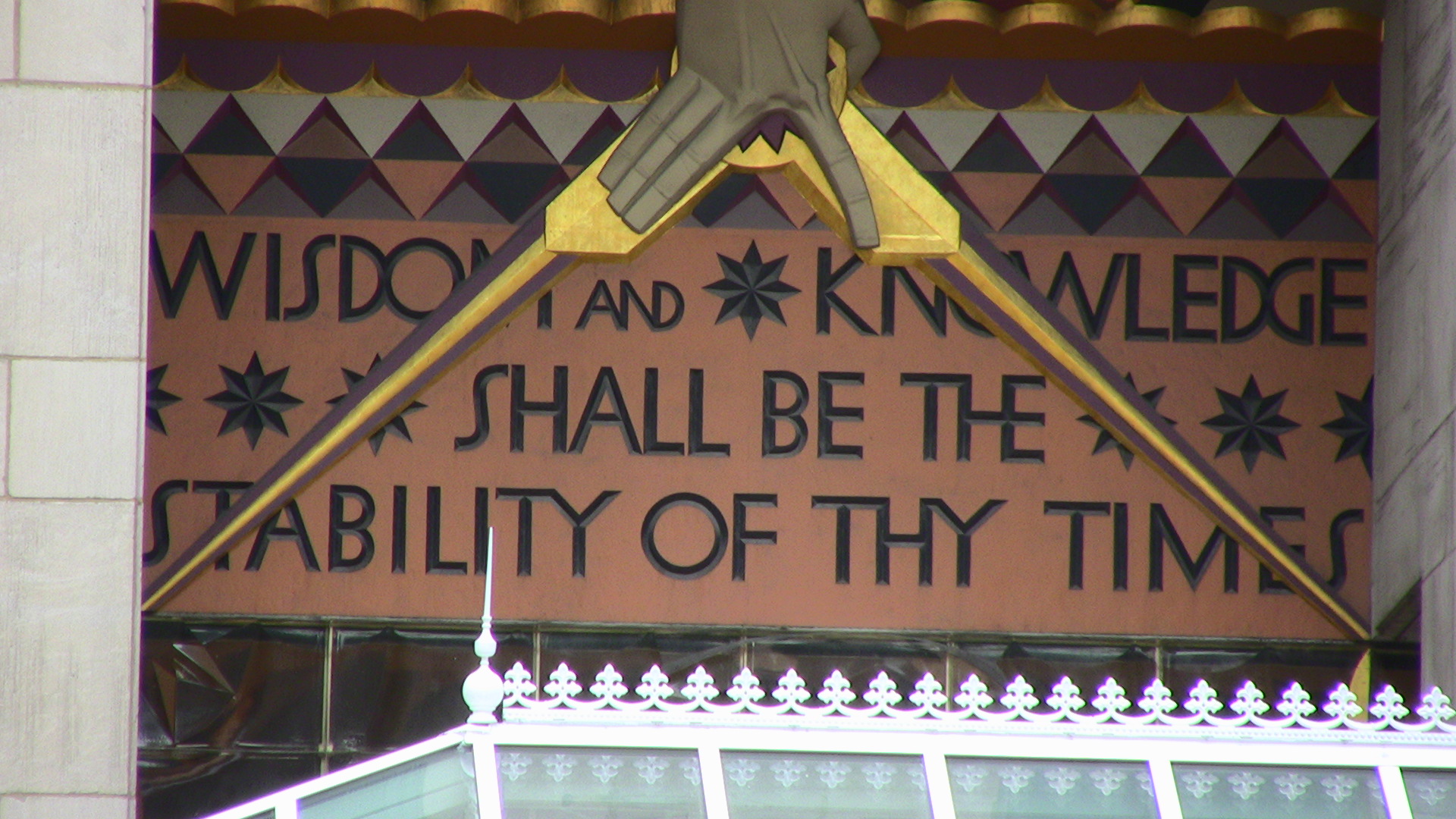
Mural above entrance to Rockefeller Plaza

SOMETIMES THE FURTHER DOWN the rabbit hole I go to research my book, the further it seems I need to go.

While working on unraveling the parallels between ancient Egypt (Khemet) and Christian beliefs I was sidetracked by the story of a Caucasian man, with a beard and flowing robes who brought peace and knowledge to a primative people. At first reading you might immediately suppose I was talking about Jesus, but I’m not.

The Bringer of Peace
This bringer of peace arrived between 15 and 10-thousand years before Jesus to what we now call South and Central America. He was known by a few names: Itzamna, Votan  and Gucumatz, and in the North: Kukulkan and Quetzalcoatl translated to mean ‘Plumed (or feathered) Snake’.

All of the legends state that he arrived from across the Eastern Sea and that he departed saying he would return one day, but couldn’t be more specific. Which makes it easy to understand why native Americans put up no resistance when the Conquistadors arrived in the 16th century…that they believed Cortez with his pale face and shining armour was the return, or ‘second coming’ of their saviour. Oops.

Evil Triumphs
So why did Quetzalcoatl go away? Legend says that the age of enlightenment ended at the hand of Tezcatlipoca, an evil minded god whose name means ‘Smoking Mirror’, after a near cosmic battle. As soon as Quetzalcoatl was gone human sacrifice and over-all bad behaviour was re-instated.

While researchers such as Graham Hancock believe that based on the consistency of the story throughout pre-Columbian society, Quetzalcoatl was indeed a historical figure and not a personification of celestial events. However, could that battle have been the original inspiration for the ancient Egyptian daily battle between Horus (the Sun god) and Set? The never-ending battle between good and evil…?

The Christian Connection
Bring it all forward in time and mix it with the 2nd century Gnostic belief in 2 gods:  one good (the god of the spirit world) and one evil (the god of the material world), the same belief which was later adopted by the Cathar and Bogomils … and you start to have some interesting thoughts. Particularly of the parallel between the Plumed Snake and the Judeo-Christian snake of Eden…tempting Adam and Eve with the fruit of ‘knowledge’.

Bill Maher
As Bill Maher put it in last weeks episode of Real Time with Bill Maher (Episode 240 3:30), “…Adam and Eve…screwed it up for everybody when they ate an apple from the tree of KNOWLEDGE,” and continued, “Rick Santorum home schools his children because he does not want them eating that…apple”.

Ironically, the Cathar who brought equality, peace and knowledge to the North-Western Mediterranean were slaughtered wholesale by the Catholic Church in the 14th century AD, becoming what one could see as “the modern day Tezcatlipoca”. It can only be lamented as to the kind of world we would be living in today had the open mindedness of Catharism been allowed to flourish.

The perpetual battle between good and evil…light and darkness…spirit and matter…continues…

PROBLEMA the Film


Who are we in the 21st Century?

A cinematic interpretation of the world’s largest round table gathering, PROBLEMA is a visually imaginative, thought-provoking invitation to a world of global dilemmas. Spanning seventeen questions confronting who we are and where we’re going, the film follows the insights, perceptions, reflections and views of over 100 people from more than 50 nations sat together in one circle.

A not-for-profit production, PROBLEMA is freely available to watch and to download via their website. If you’d like to support the film, we encourage you to host a screening, to sign our guestbook or to consider making a micro-donation to help further its human connection.

My Uncle Kamal Boullata was one of the guests invited to speak.

Welcome to The Nous Age


I‘m thrilled you’ve discovered my corner of the world wide web and I hope you decide to jump into the discussions below or at least subscribe in the top right corner. I don’t care if you disagree vehemently or agree with me whole heartedly (or are somewhere in between like most of my readers) I personally invite you to become a part of our discussion.

Why This Website
This website is a sketch pad for my ongoing research, which I plan to publish as a book tentatively titled The Door to The Nous Age. It’s where I am connecting the dots between cutting edge scientific research in quantum physics and psi, and religious traditions from around the world. It’s a place for me to pose theories and hypotheses on this building alignment of science and spirit and what it means to our modern “connected” world. It’s also a place for me to field criticisms and be inspired to move my research into new directions. And along the way, you’ll get a sneak peek into what you can expect from my book.

Full Disclosure
I am neither a scientist nor a theologian and I don’t pretend to be.

What I am is a journalist with an insatiable curiosity and desire for taking things apart to understand why they work and how they work. From a journalistic point of view I am documenting new scientific discoveries and attempting to coorelate them to what religions have been saying for thousands of years. And because I like Indiana Jones so much (who doesn’t), a bit of archeology to help us better understand the world dominant Abrahamic religions and what clues to our past they’ve been hiding in plain site all this time. Is it possible that we are only re-discovering what a civilization that predates known history already knew?

Objectivity
Some would ask what business I have talking about science when I’m not a scientist; or talking about religion when I am likewise not an expert. In two words: objective journalism. I think it’s precisely that I don’t have any so called professional truths to uphold that I am able to explore ideas unencumbered by either religious, scientific or archaeological dogma.

What I Believe
We are in the midst of some kind of paradigm shift, NOT a cataclysmic shift like many doomsday-ers are predicting but simply a change in the way we see ourselves as a society, as a species, as a planet. And this change in perspective that we are moving into is what I call The Nous Age…welcome!

Make Your Own Path


There’s a Buddhist saying that describes religion as being like a raft, once you’ve crossed the river you don’t carry that raft on your back to your destiniation, do you? After you’ve made it to the opposite shore leave your raft there and continue on foot without the oppressive weight of your raft (or religion) on your back.

Likewise there is another Buddhist saying that insists that if religion were a raft don’t stay on it too long or you will get washed out to sea where you will be forced to stay and deal with the consequences.

Religion A Good Start
I’ve always said that religion is an excellent starting point for a spiritual life…sort of like ‘Spirituality 101’. But after that you’re on your own, you need to make your own way.

Most of the problems on Earth are caused by people who are trying to carry their raft…or who have stayed on their raft too long.

Your Path to Enlightenment
There are 6 1/2 billion people on the planet and there are 6 1/2 billion paths to enlightenment. We are creative souls…get creative…ask questions!

Don’t carry your religion like a raft, don’t stay on your raft too long and mostly importantly, don’t follow me….make your own path.

Our World Within A World


On a recent visit to New York City I was thrilled to finally be able to stop and visit the United Nations. Although I have been to New York many times in my life I never had the time to visit.

After passing through security I was taken on a tour by a brilliant yet soft spoken young Japanese man and learned many things about the history of the U.N. I highly recommend taking the tour when you’re in The World’s City as they call it.

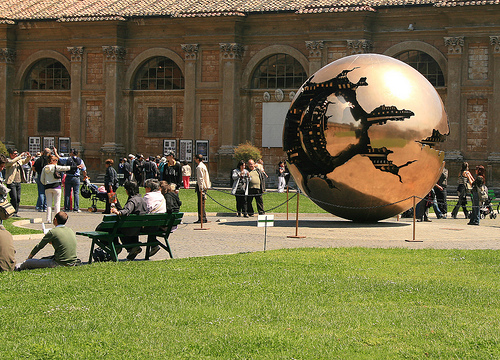
After the indoor tour I made my way outside to the North west corner of the U.N. plaza to see for myself, upclose and in person the sculpture which sits there called Sfera con sfera or Sphere within a Sphere. I had been anticipating this for quite some time.

The sculpture was created by an Italian named Arnaldo Pomodoro who lives and works in Milan.  It was presented as a gift to the United Nations by Lamberto Dini, Minister for Foreign Affairs of Italy  and unveiled on November 21, 1996 in New York City.

The first time I saw a picture of this sculpture I was dumbstruck not because of it’s apparent message but because of it’s placement…not here at the U.N. but at the Vatican! There, a duplicate of the sculpture sits in the middle of the Cortile della Pigna, placed like a child’s discarded toy in the middle of the walkway. (picture below)

Courtesy @l+q's photostream at Flickr

 The Connection
So what’s the connection between the Vatican and The United Nations? And what’s the message of this sphere with in a sphere sculpture?

I’ve dubbed it The World within a World sculpture because I believe that we live in 2 worlds. The first is the one that we perceive as being real with our daily struggles and concerns, errands to run, problems to fix. The second is the true world with it’s infinite beauty and simplicity. 

My Interpretation
The second world is hidden from us by the first world, perhaps on purpose. Our struggle as human beings is to be able to see through the illusion of the first (material) world and discover this inner world of peace…of becoming illuminated. 

Are these spheres placed where they are to give us a clue to what lies within? Will the “lifting of the veil” described in the book of Revelations in the Bible be our discovery of this “world within the world”?

Welcome to The Nous Age!