LISTEN TO THE AUDIO VERSION
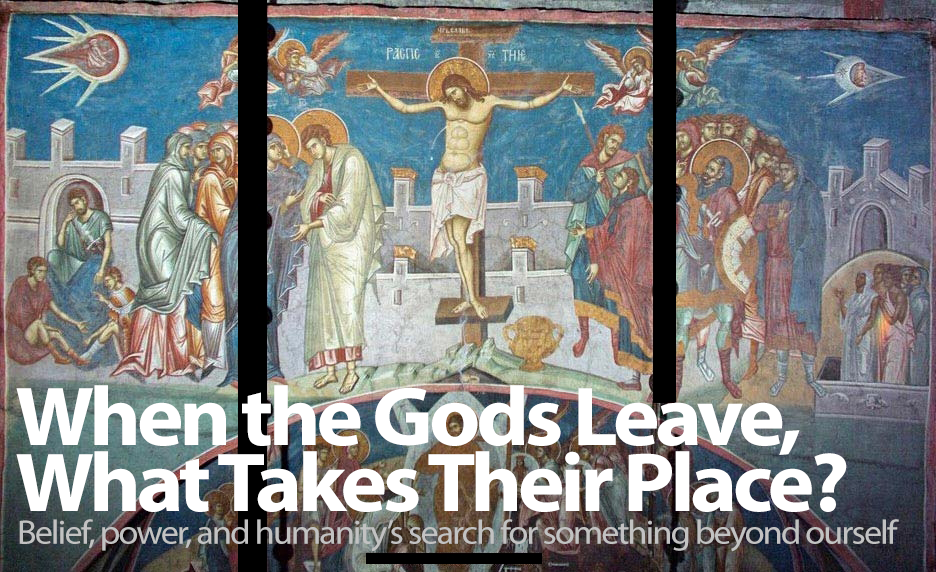
Two thousand years ago, the Greek philosopher Plutarch observed that you could find cities without walls, kings, or wealth…but not cities without gods.
Two thousand years later, the gods appear to be leaving.
The question is whether our need for them went with them.
Across much of the Western world, organized religion has been losing its hold. Churches that once stood at the centre of community life struggle to fill their pews. Increasing numbers of people describe themselves as having no religion at all. Institutions that once claimed enormous authority over questions of morality, meaning, death and eternity no longer command the automatic obedience they once did.
It would be easy to conclude that humanity is simply becoming less religious.
But perhaps something more interesting is happening.
Perhaps belief doesn’t disappear.
Perhaps it changes containers.
The Space Religion Occupied
For thousands of years, religion did considerably more than tell us what happened after we died.
It placed us inside a story.
It told us where we came from. Why we were here. What was expected of us. What existed beyond the visible world. Whether there was an intelligence greater than our own. Whether someone or something was watching.
Religion provided community, ritual and moral structure. But it also provided mystery.
And human beings seem remarkably uncomfortable living without mystery.
This doesn’t mean religion was created simply to control people. History is rarely that tidy. Belief can emerge sincerely among ordinary people while institutions subsequently discover that belief has another property:
It has power.
Ancient Rome provides an extraordinary example.
When Rome Changed Its Mind
For centuries, Christians periodically faced Roman persecution. Their refusal to participate in aspects of Roman religious life could be interpreted as defiance of the social and political order.
Then something remarkable happened.
Rome stopped trying to destroy Christianity and began embracing it.
Constantine legalized Christianity in the early fourth century and increasingly patronized it. Later in that century, under Theodosius I, Nicene Christianity became bound increasingly closely to imperial authority.
But Rome did not invent Christianity. By the time Constantine embraced it, Christian communities had flourished for centuries across the Eastern Mediterranean, including ancient traditions that would eventually form the foundations of Eastern Orthodox Christianity.
Rome’s great achievement may therefore have been something subtler than creating a religion.
It recognized the power of one that was already there.
Imperial authority became involved in Christian disputes. Councils helped define orthodoxy. Certain interpretations became authoritative while others were increasingly pushed outside the boundaries of acceptable belief. Christianity itself developed within the surrounding Greek and Roman world, absorbing its language, philosophy and cultural environment.
Over time, belief and institutional power became deeply intertwined.
The lesson isn’t necessarily that powerful people invent religions to control populations.
The more interesting lesson may be that institutions can recognize an emerging belief system, organize it, legitimize particular interpretations of it and eventually become authorities over it.
Which brings us, rather unexpectedly, to the sky.
Something Is Changing Above Us
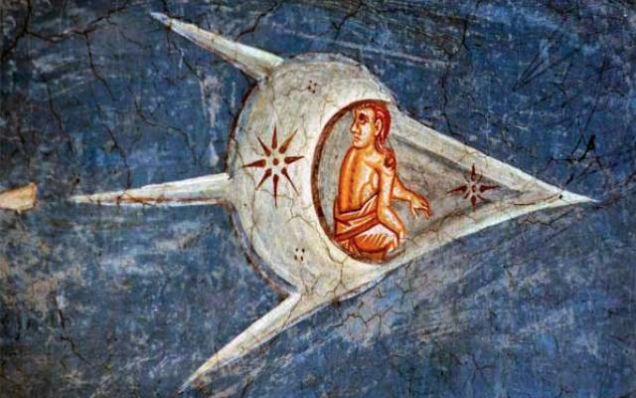
For most of the modern era, UFOs occupied the cultural territory of science fiction, tabloid newspapers and conspiracy theories.
That has changed.
With the Pentagon’s latest release of previously classified UAP material, the sixth release of its kind in roughly five months, we are being given another glimpse into just how seriously parts of the U.S. government have investigated phenomena once dismissed to the fringes. The newly released material includes records connected to a secretive military program that commissioned studies into subjects as extraordinary as wormholes, exotic propulsion and the possible biological effects of unexplained encounters.
None of this proves extraterrestrials are visiting Earth.
That distinction matters enormously.
But something culturally important can be happening regardless of whether a single extraterrestrial spacecraft has ever entered our atmosphere.
Look at the questions increasingly surrounding the phenomenon.
Are we alone?
Is there an intelligence greater than ours?
Where do we come from?
Could another intelligence have been watching us?
Is reality larger than what we can perceive?
What happens when humanity finally discovers that it isn’t at the centre of everything?
Those aren’t merely scientific questions.
They are some of the oldest questions human beings have ever asked.
We once carried many of them into temples and churches.
Increasingly, we’re carrying them elsewhere.
A New Container
This doesn’t require a secret government plan.
In fact, that’s precisely what makes the possibility more interesting.
Rome didn’t need to invent Christianity to recognize its cultural power. Christianity was already there.
Perhaps modern institutions don’t need to invent our fascination with extraterrestrial intelligence either.
It is already here.
The important question therefore may not be whether governments are preparing us to believe in extraterrestrials.
It may be what happens if millions of people begin believing anyway.
Who interprets the phenomenon?
Who determines which information is credible?
Who possesses the secret knowledge?
Who decides what gets revealed?
And perhaps most importantly: who becomes the authority standing between ordinary people and something they cannot understand for themselves?
Those questions should sound strangely familiar.
Because we’ve asked versions of them before.
Perhaps the most interesting thing about the decline of organized religion isn’t that Western societies are abandoning belief.
Perhaps we’re watching belief migrate from churches and scriptures toward consciousness, the cosmos and the possibility that we are not alone.
Plutarch couldn’t imagine congressional hearings about unidentified objects moving through the sky.
But I suspect he would recognize the people watching them.
Because two thousand years later, humanity may still be doing what it has always done:
Looking upward.
Searching for something greater than ourselves.
Trying to understand our place in an enormous and mysterious universe.
Perhaps belief doesn’t disappear.
Perhaps it simply changes containers.

